Teeth Grinding and Clenching: The Hidden Damage to Your Teeth and Jaw — and How a Night Guard Can Help
Teeth Grinding and Clenching: The Hidden Damage to Your Teeth and Jaw — and How a Night Guard Can Help
Are you waking up with jaw discomfort, headaches, or sensitive teeth? Do you notice that your teeth are becoming shorter, flatter, or chipped? You may be experiencing the effects of teeth grinding or clenching, also known as bruxism.
Many people grind or clench their teeth without realizing it, particularly during sleep. Although these habits may seem harmless, excessive or repetitive forces can contribute to tooth wear, fractures, damaged restorations, and discomfort in the muscles responsible for chewing.
At Fort York Dentist, we believe that early identification of destructive oral habits is essential for protecting natural teeth, dental restorations, and long-term oral health.
A professionally designed night guard or, in selected cases, a therapeutic temporomandibular joint (TMJ) appliance may help protect your teeth and manage certain symptoms associated with these conditions.
What Are Parafunctional Habits?
Parafunctional habits are activities involving the teeth, jaws, or oral muscles that occur outside normal functions such as chewing, speaking, and swallowing.
Common examples include:
- Bruxism: Grinding or clenching the teeth, either during sleep or while awake.
- Daytime clenching: Holding the teeth tightly together, often during concentration, stress, or demanding activities.
- Nail biting: Repeatedly biting the fingernails, which can place unnecessary stress on teeth.
- Chewing on objects: Habitually biting pens, pencils, or other hard objects.
- Cheek or lip biting: Repetitive habits that may irritate the soft tissues.
- Jaw bracing: Holding the jaw muscles tense for prolonged periods without necessarily bringing the teeth together.
Among these habits, bruxism is particularly important because of its potential effects on teeth, restorations, and the chewing muscles.
What Is Bruxism?
Bruxism is repetitive jaw-muscle activity characterized by clenching, grinding, or bracing of the jaw.
There are two main forms.
Sleep Bruxism
Sleep bruxism occurs during sleep and may involve rhythmic or sustained activity of the jaw muscles.
Patients are often unaware of the activity until a family member notices grinding sounds or a dentist identifies signs of excessive tooth wear.
Awake Bruxism
Awake bruxism occurs during waking hours and often involves prolonged tooth contact, clenching, or jaw bracing.
It may be associated with concentration, emotional stress, or certain habitual behaviours.
Unlike normal chewing, these activities can expose the teeth and supporting structures to repeated or prolonged mechanical loading without a functional purpose.
Not everyone who experiences bruxism develops significant dental damage. However, patients with destructive tooth wear, fractures, or muscle symptoms may benefit from a detailed dental assessment.
How Can Teeth Grinding and Clenching Damage Your Teeth?
The destructive effects of bruxism may develop gradually over several years or become noticeable following a tooth or restoration fracture.
1. Excessive Tooth Wear
One of the most recognizable signs of bruxism is flattening or wear of the biting surfaces.
Over time, patients may notice that their front teeth appear shorter or that the cusps of their back teeth have become flattened.
When enamel is lost, the underlying dentin may become exposed, increasing the risk of sensitivity and further wear.
Severe tooth wear can affect the shape, appearance, and function of the dentition.
Although grinding is an important possible contributor, tooth wear can also result from erosion, abrasion, and other factors. A proper diagnosis is essential.
2. Cracked and Fractured Teeth
Repeated excessive loading may contribute to cracks or fractures in susceptible teeth.
A patient may experience sharp discomfort when biting, sensitivity to temperature, or intermittent pain that is difficult to localize.
Some cracks remain superficial, while others extend deeper into the tooth.
If a crack involves the dental pulp, root canal treatment may become necessary. In severe cases, the tooth may no longer be restorable.
Early recognition of excessive tooth loading may help reduce the risk of further damage.
3. Damage to Fillings, Crowns, and Veneers
Dental restorations are designed to withstand normal functional forces, but repeated excessive loading may contribute to complications.
Patients with bruxism may experience:
- Chipping or fracture of composite restorations
- Fracture of porcelain veneers or crowns
- Repeated failure of large restorations
- Increased wear of opposing teeth
- Mechanical complications involving implant-supported restorations
For patients who have invested in extensive restorative treatment, protecting the restorations against excessive loading can be particularly important.
4. Tooth Sensitivity and Discomfort
Excessive tooth loading may contribute to tenderness of the periodontal ligament, particularly when biting or chewing.
Patients may also experience sensitivity associated with exposed dentin, tooth wear, or cracks.
Because similar symptoms can occur with dental decay, pulp inflammation, and infection, a comprehensive examination is necessary to identify the cause.
5. Jaw Muscle Pain and Fatigue
The masseter and temporalis muscles play an important role in chewing and jaw movement.
Prolonged clenching or repetitive grinding may contribute to muscle fatigue, tenderness, and discomfort.
Some patients report:
- Jaw stiffness after waking
- Tenderness in the cheeks or temples
- Difficulty chewing comfortably
- Tension-type headaches
- A feeling of tiredness in the jaw muscles
These symptoms may also have other causes and should not automatically be attributed to bruxism.
6. Temporomandibular Disorders (TMD)
The temporomandibular joints connect the lower jaw to the skull and allow movements necessary for speaking, chewing, and opening the mouth.
Temporomandibular disorders, commonly called TMD, involve conditions affecting the jaw joints, chewing muscles, or associated structures.
Patients may experience jaw pain, limited opening, joint noises, or discomfort during movement.
Bruxism and TMD may occur together, and excessive jaw-muscle activity can aggravate symptoms in some individuals. However, bruxism is not the sole cause of TMD, and the relationship is complex.
Not every patient who grinds their teeth develops a TMJ disorder.
Why Is Early Treatment Important?
One of the challenges of destructive parafunctional habits is that damage may progress without significant pain.
Patients may not recognize the problem until they experience a broken tooth, repeated restoration failure, or substantial loss of tooth structure.
Unlike skin or bone, lost tooth enamel cannot regenerate naturally.
When significant tooth structure is lost, restorative procedures such as composite bonding, crowns, or more extensive rehabilitation may become necessary.
Early diagnosis and appropriate management can help protect the remaining tooth structure and reduce the risk of additional complications.
What Is a Night Guard?
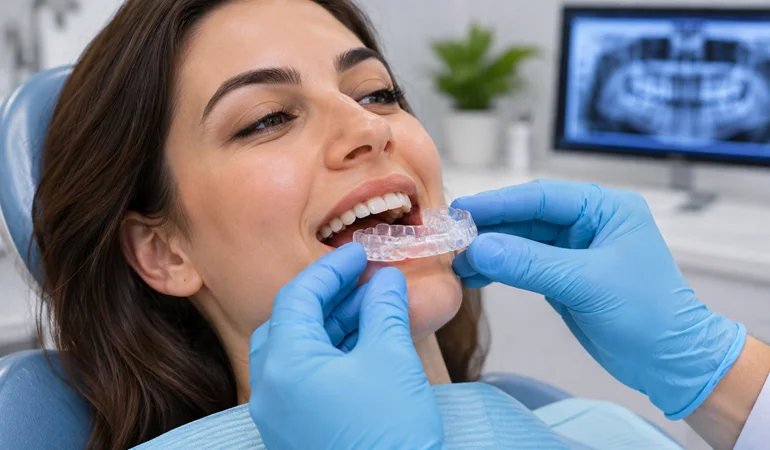
A night guard, also called an occlusal splint, is a removable dental appliance typically worn over the upper or lower teeth during sleep.
Its primary purpose is to provide a protective surface between the teeth and distribute occlusal contacts according to its design.
A properly selected and fitted appliance may help reduce certain consequences of grinding and clenching.
Importantly, a night guard does not necessarily stop sleep bruxism itself. Rather, it can protect teeth and restorations from direct contact and may help manage associated symptoms.
How Can a Custom Night Guard Protect Your Teeth?
A professionally fabricated night guard may offer several benefits.
Protection Against Tooth Wear
The appliance creates a protective barrier between opposing teeth, helping reduce direct tooth-to-tooth wear during grinding.
Protection of Dental Restorations
Patients with crowns, veneers, bridges, or extensive composite restorations may benefit from an appliance designed to protect their restorations from excessive mechanical loading.
Management of Muscle Discomfort
Some patients experience improvement in jaw-muscle discomfort while using an appropriately selected stabilization splint.
However, symptom improvement varies, and a night guard is not a guaranteed treatment for jaw pain or headaches.
Long-Term Dental Protection
For patients with ongoing destructive grinding, a custom appliance may be an important part of a preventive dental care plan.
The appliance should be periodically examined and adjusted when necessary to maintain appropriate fit and occlusal contacts.
Is a Regular Night Guard the Same as a TMJ Appliance?
Although these terms are sometimes used interchangeably, not all occlusal appliances are designed for the same purpose.
A conventional protective night guard is generally intended to reduce direct tooth-to-tooth contact and protect dental structures from grinding-related damage.
A therapeutic TMJ appliance may be designed with specific occlusal contacts or functional objectives to help manage selected jaw-muscle or joint-related symptoms.
Different appliances may include full-coverage stabilization splints, anterior-contact appliances, or other designs chosen according to the patient’s diagnosis.
The appropriate appliance depends on the patient’s symptoms, occlusion, dental condition, and clinical findings.
For example, an appliance intended primarily to protect teeth from grinding may differ from one prescribed for a specific temporomandibular disorder.
Therapeutic TMJ appliances should be prescribed and monitored by a dentist familiar with their indications and limitations.
No single appliance design is suitable for every patient.
Can a TMJ Appliance Correct Jaw Joint Problems?
This is an important distinction.
Some occlusal appliances may help reduce symptoms associated with certain temporomandibular disorders, particularly muscle-related discomfort.
Joint clicking may be associated with disc displacement, but clicking alone does not always require treatment.
Patients with persistent pain, locking, restricted opening, or significant functional limitations should receive an appropriate clinical assessment.
Treatment may involve patient education, behavioural modification, physiotherapy, an occlusal appliance, or other conservative approaches depending on the diagnosis.
Why Choose a Custom-Made Night Guard Instead of an Over-the-Counter Guard?
Over-the-counter night guards are widely available, but they may not provide the same level of individualized fit or occlusal control as a professionally fabricated appliance.
A custom night guard is made using impressions or digital scans of the patient’s teeth.
Its design can be selected according to the patient’s dental condition, occlusion, restorations, and treatment objectives.
Potential advantages include:
- More individualized fit and retention
- Professional assessment of occlusal contacts
- Selection of an appropriate appliance design
- Monitoring for changes in symptoms or occlusion
- Adjustment or replacement when necessary
An appliance that is uncomfortable, poorly fitted, or unsuitable for the patient’s condition may be ineffective or contribute to additional problems.
A dental examination is recommended before beginning long-term appliance therapy.
Can Stress Cause Teeth Grinding?
Stress and emotional tension may contribute to awake clenching and can be associated with sleep bruxism.
However, bruxism is a multifactorial condition.
Sleep-related factors, certain medications, and other health conditions may also be relevant.
Patients may benefit from becoming more aware of daytime jaw habits.
During rest, the lips can remain gently closed while the teeth are slightly apart and the jaw muscles are relaxed.
Avoiding unnecessary tooth contact during the day may help reduce prolonged muscle loading.
For some patients, stress management, sleep assessment, or other supportive measures may also be appropriate.
Do You Need a Night Guard?
A dentist should consider the severity and progression of tooth wear, the presence of fractures, muscle symptoms, existing restorations, and other relevant findings.
A custom night guard may be recommended when there is evidence of destructive grinding, repeated restoration damage, or another appropriate clinical indication.
Patients with jaw pain or suspected TMD may require additional evaluation before an appliance is selected.
The goal is to choose treatment based on the patient’s individual needs rather than prescribe the same appliance for everyone.
Protect Your Natural Teeth Before Significant Damage Occurs
Your natural teeth are valuable, and preventing unnecessary damage is an important part of long-term dental care.
If you frequently clench your teeth, wake up with jaw discomfort, experience repeated fractures of dental restorations, or notice excessive tooth wear, a dental assessment may help identify the cause.
At Fort York Dentist, we assess dental wear, occlusal conditions, and symptoms associated with parafunctional habits to help patients understand their treatment options.
When appropriate, a custom night guard or therapeutic occlusal appliance may be recommended as part of an individualized treatment plan.
Book a Night Guard or TMJ Assessment
Don’t wait until a tooth fractures or extensive wear develops.
Contact Fort York Dentist in Toronto, Ontario to arrange a dental examination and discuss whether a protective night guard or TMJ appliance is appropriate for you.
Call 647-346-8888 or book your appointment online.
Disclaimer: This article provides general dental information and does not replace a clinical examination or individualized treatment recommendation. Bruxism, tooth wear, and temporomandibular disorders require appropriate diagnosis before treatment.
Related posts
Recent Posts


Client Testimonials
The Fort York Dentist team is amazing. I’ve been a patient here for the last few years and they’ve consistently accommodated my schedule and my needs. I’ve also had a positive experience with Invisalign procedure at this clinic.

Tetyana Krysa
I’ve moved away from Toronto and I miss Dr. Hosseini! Competent, kind, reassuring and even a little bit fun! She took extra time to fully explain what she was doing to help me. A terrific dentist & good hygienists staff.
Janine Gliener
I have been coming to Fort York Dentist for several years and have had a consistently pleasant experience. The team is friendly and welcoming, and I appreciate the care they take in cleaning my teeth. Their attention to detail and gentle approach always leaves me with a reason to smile! 😀